Monday, December 12, 2011

Just What Is A Character To Do?

Robert P. Bennett, author of the Blind Traveler mysteries, is my guest. His blind protagonist, Douglas Abledan, navigates the world through a talking GPS, but it doesn't stop him from stumbling over bodies. Fascinating books!
An eBook available for most e-readers
Who are the people writers write about? Why are they chosen as subjects? These questions are valid for both nonfiction and fiction writers. We art taught from an early age that we must find the good things in each person we meet. The same lesson holds true for writers as well as it does for children. Each of us has to find something good, something interesting, in the people we write about. In my writing career I’ve chosen to focus on a specific group of people, those with disabilities. I’ve looked at what they do and how they do it. Over the years I’ve found many points of interest for my readers: technology, politics and, of course, the characteristics of the individual people themselves. Among the areas I’ve found to be the most interesting are the hobbies that they have chosen to pursue. Some played sports. Others played instruments.  Still others choose to study a particular subject. In other words, people with disabilities choose hobbies that are no different than their able-bodied counterparts. In some cases they may have to pursue those interests in slightly different ways, but they are all the same.
Available in most eBook formats
In creating a protagonist for my fiction I have leaned heavily on the things I learned about people when I was writing magazine articles.   I once wrote an article about a piece of technology that allowed a blind man to navigate through his world using a combination of GPS and virtual reality. I took that technology and built a fictional character around it. Thus was born Douglas Abledan and the Blind Traveler Mysteries. As I write more about his adventures, I realize that Douglas has to become more and more “real.” He has to become three-dimensional. So, not only do I have to create his world, not only do I have to give him a physical appearance, but I also have to furnish him with a job and hobbies.
From the beginning I gave Douglas a love of music, specifically Jazz. While a sighted person might learn to read music from a sheet, Douglas learned to distinguish the different notes that make up the songs he likes simply by listening to them repeatedly. He plays them on a harmonica, admittedly not very well. I also imbued him with a sense of what the world looks like, its natural as well as man-made structures. With this quality he has developed an interest in architecture. Using his hands as a sighted person would use his eyes; Douglas is able to distinguish, with a fair degree of accuracy, what a structure looks like. Through study, he has learned the difference between the Art-and-Crafts style of architecture that flourished in the late 1860s and the structures that borrow design elements from of the Greco-Roman period. And, with his nimble fingers, he can feel the differences.
As writers we must give our material as well-rounded an appearance as possible. Whether we write fiction or non-fiction the goal should be the same. Flesh out the people you write about. Show your readers who they are. And remember, it is just as important for a fictional character to have hobbies and interests as it is for those in the “real” world. Not only will these make your characters more interesting. They will also present your readers with another avenue to connect with and care about those characters.
_________________________
About Robert Bennett
Robert Bennett is a social worker and writer who focuses on issues of disability. His articles, which appear in both local and national publications, have spanned a wide range of topics. He has spoken to groups of physical therapy students, church members and senior citizens, and has appeared on several radio programs. In writing about the issues people with disabilities are involved with he feels he has learned a very important lesson, "It is the act of truly living and believing in yourself that is important, not the manner in which that action is undertaken." Contact Mr. Bennett through his website at

Friday, December 9, 2011

Una Tiers Interviews Ellis

I'm delighted to interview Ellis Vidler about her new book, Cold Comfort.  Let's start with a little background about your first two novels, Haunting Refrain and The Peeper.
My grandmother had a streak of psychic ability—she knew when something was wrong with a family member, so that sort of thing always interested me. I don't know how Haunting Refrain came to me, but that's what I wanted to write. After a writing class with Scott Regan, I decided I'd better get on with it.
I met Jim Christopher, a South Carolina Law Enforcement Division (SLED) veteran, and he had an idea for a story. He asked if I'd like to write it with him. It was such fun, and I learned so much from him.
And you just published some short stories?  Yes, Tea in the Afternoon, is a collection of three Southern stories, based on remembrances I heard and people I knew, but they're entirely fictitious.
You have a touching dedication to Tea.  It's dedicated to my parents, who gave me a wonderful childhood. We lived in a small town in Mississippi where my friend and I rode double, barefoot and bareback, on her horse though fields and back roads. We stopped at farmhouses for water for us and the horse.
Then my family moved to another small town in Alabama, where I played outside all day, usually in the river bottom or woods. The rule was home by dark. It was a different world.
Can you tell us an early memory about your parents and books? My father read Tarzan of the Apes and the Oz books to me when I was very young. Tarzan remains one of my favorites. Mother read to me too. They said, "You'll learn to read for yourself when you go to school." I cried after my first day of kindergarten because they didn't teach me to read.
 Now we can talk about Cold Comfort. Where is the book set? Claire, my protagonist, owns a Christmas shop in Williamsburg, VA.  There are also scenes on the South Carolina coast at McClellanville and Georgetown and some in Washington, DC.
How did you create your villain? I usually see the characters first, and he suited the crime I had in mind. He did evolve a little more as I wrote, but I saw him from the beginning.  You identify aftershave and tobacco with him.  Why? Both are unpleasant smells to me and seemed to fit in his character. I wanted Claire to have hints of trouble but nothing specific at first.
What about Claire Spencer, where did she come from? Claire’s strong sense of doing what she has to came from a friend I admired.  The rest of her grew and developed as I wrote. My critique partners thought she was too ladylike and pushed me to make her tougher. They were right. She's not a kickass type, but she's strong and determined.
Your pace in Cold Comfort is fast.  How do you help the reader mark how much time has passed? Goodness, I don't know. I guess I just tell when the scenes occur. You know, in the morning, by mid afternoon, at four o'clock, whatever it is. All my books take place in a short period of time. I like the sense of urgency that comes from time limits.
You are so prolific, what's next? I'm working on two books, one about Kate McGuire's friend Gwen, from Haunting Refrain, and a character from Cold Comfort. This one begins on Isla Mujeres in Mexico and ends up in the southeastern United States.
The second one is about Kate's cousin, Alex Jenrette, who also has some inconvenient psychic ability. It's set on a fictitious island off the coast of Charleston, SC. I love the bad guys in this one, but the good guy is giving me trouble. I think he needs a personality transplant.
Thank you for meeting with me, Cold Comfort sounds great.
            Una, you're a dear to do this. I can't wait till your book, Judge vs Nuts, comes out. You're such a funny character yourself, I know it's going to be a fun read. I expect you back when it's released.
Here's Una's cover. Her book will be released soon.

Ellis's Book is available at

http://tinyurl.com/ev-cc-Smash
http://tinyurl.com/ev-cc-Omni
          http://tinyurl.com/ev-cc-Kindle

Monday, December 5, 2011

Giving It Away

 What a fun person Marian Allen is! I love the trailer for Force of Habit. Now I must get the book.

30-second YouTube spot: http://www.youtube.com/watch?v=l2FWEq-sxZM 

When Bel Schuster swaps clothes with a native and goes off-limits on the planet Llannonn, she lands in several flavors of hot water. Alien criminals, local slavers and the planet's own particular legal code end up in a baggy-pants courtroom drama.

Giving It Away

When my previous book, EEL'S REVERENCE, came out, I ran a contest during my blog book tour for it. One of the prizes was the right to name a character in a short story I pledged to write to promote FORCE OF HABIT. The winner of the drawing was one Holly Jahangiri.

Now, I had "met" Holly in Dani Greer's Blog Book Tour class, but she was only a slight acquaintance. When she won the contest, I started following her blog, I "friended" her on FaceBook and I "traded follows" with her on Twitter.

After a few months, I got an idea for the story: On the planet Llannonn, living books--people who, as in Bradbury's FAHRENHEIT 451, memorize and recite texts--live in a cross between a library and a rooming house. Some of them go missing. The librarians and a cop team up to solve the mystery.  I would call it "By the Book".

Like FORCE OF HABIT, the story would be sf/crime/humor. Holly would be one of the librarians. Her Twitter avatar included a purple feather boa, so I wrote a purple feather boa into the story.

By the time I finished the story, submitted it to my publisher and went through the edits, my familiarity with Holly the character cemented my friendship with Holly the person. The connection must have manifested itself electronically because my publisher, with no input from me, made a cover for the eStory featuring -- a purple feather boa.

Holly loved the story and helped me promote it (it's free at Smashwords -- if you really want to, you can pay $0.99 for it at Nook or Kindle stores) and helped me promote FORCE OF HABIT. She even interviewed herself on my blog. <http://www.marianallen.com/2011/11/bonus-follow-friday-more-holly/>

I recently ran another contest and the right to name a character in a new short story was won by -- HOLLY! So there will be a sequel to "By the Book". I think I'm going to call it -- and this is the first announcement of the title -- "By Hook or Crook".

I'm in several writers' email lists, and the question occasionally comes up as to the benefit of contests and of giving writing away. I post free samples at http://MarianAllen.com every Sunday, some of them excerpts but many of them flash fiction stories. Although I love earning money with my writing, I find that the satisfaction of sharing my creation is vast. I hope that people who enjoy the free stuff will support me by buying something, too. And the inspiration and friendship I found through writing "By the Book" are beyond price.

I never give anything away. But some things, money can't buy.

FORCE OF HABIT

Multiple formats at OmniLit 
Amazon Kindle
Barnes & Noble Nook
Multiple formats at Smashwords 
"By the Book"
http://tinyurl.com/ma-btb-Smash (Free) http://tinyurl.com/ma-btb-Smash

Friday, December 2, 2011

Cold Comfort is officially out now!


This week is the Holiday Fair in Greenville, SC, and I'm sharing a booth with fellow authors Kathleen Delaney and Linda Lovely. We hauled in boxes of books and set up our space, then went to work at the arduous task of selling books. Linda's book is Dear Killer, a romantic suspense set on a fictitious island off the South Carolina coast. Kathleen's newest is Murder Half-Baked, a California coast traditional mystery. Mine is Cold Comfort, which ranges from Williamsburg, VA, to the South Carolina coast.  We met lots in interesting people, some readers, a few interested in writing. Here are some pictures of us and our neighbors the SC Wildlife Sanctuary.
Linda, Ellis, Kathleen
Did I mention that this show is three loooong days? That we come home and collapse and wonder why we do these things? Still, it really is fun to talk to readers and occasional writers. We've met some awesome librarians (some of our favorite people) and also some English teachers (who hold a special place in our hearts). It's fun, just tiring. :-)
Awed visitor

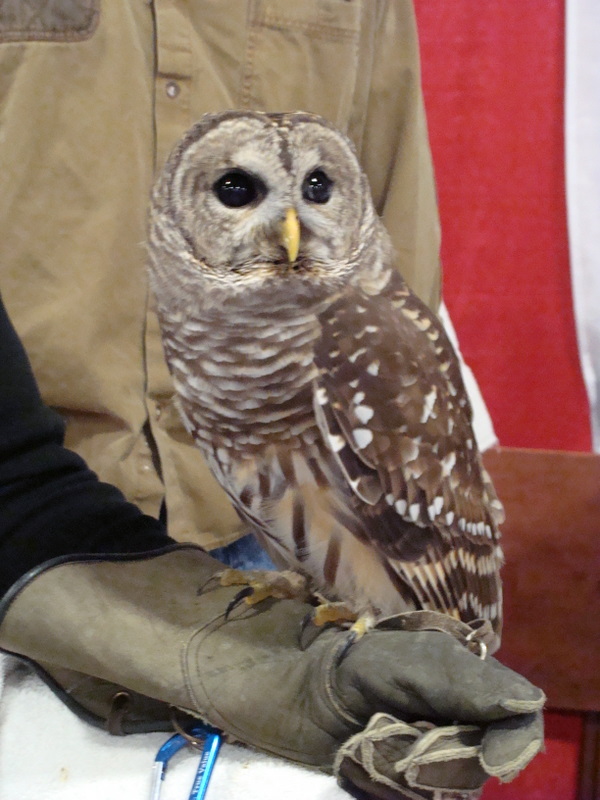
Barred owl from our neighbor, the SC Wildlife Sanctuary.
He's gorgeous, blinded in one eye so he can't hunt.
A tiny little screech owl. He comes out for two or three
hours at time and calmly watches the visitors.

Sunday, November 27, 2011

Plain Talk

My guest this week is Michele Drier, author of SNAP and Edited to Death.
Language changes.  It’s a flexible tool, adding, dropping and adapting words to reflect new ideas, new ways of doing things, naming new products.
   Take “google”, or “Google” or “googol”.  “Googol” is a math term, a one followed by 100 zeros; “Google” is a proper noun, the name of an internet company, and “google” is now a verb, meaning to look something up in the search engine “Google”.
  And all of this has happened in slightly more than ten years.
There are benefits to having this flexibility to add or change words, but I fear that I’m becoming a language curmudgeon. 
   It’s not that I object to new words, although I’m not always au courant—I had to ask my daughter how to spell “ginormous” when I used it in “SNAP: The World Unfolds”.  I was writing about a hip, young magazine editor who would use that word liberally.
   I am concerned about the creeping verbalization of our language—turning nouns into verbs—taking over much of our communications.  This trend comes from jargon.
   One of the earliest examples I heard was copspeak when I was on a drunk-driving jury more than.....years ago.  I was a staff writer for the San Jose Mercury-News, and worked with editors who were TRUE language curmudgeons.  I was stunned when I heard one cop testify that “the subject exited his vehicle”.  Hair on the nape of neck rose at that use of a noun meaning “the way out.”  In fact, the English don’t use “exit”, the arrows point to “Way out”.
   Fast-forwarding , as an editor at a mid-sized daily newspaper, one of my reporters wrote “the car exited the freeway”.  We had a chat.  I suggested that he could better say, “the car took the off-ramp,” or “the car left the freeway” and, for as long as I was his editor, he found other verbs to describe the act of driving a car off the freeway onto a surface street.
   My second pet peeve was “task”.  Task is a noun describing something to be accomplished; a chore, a piece of work.  When I heard a co-worker saying that he had been “tasked” to do something, my teeth hurt.  He’d been “asked” or “assigned” or even “told”, but “tasked”? Please!
   I realized that I was fighting a losing battle when the Taliban started their first actions in Afghanistan.  People in the news biz started talking about the “Afghans”  fleeing.  The only thing I could visualize was large brown-and-yellow knit couch throws suddenly sprouting stick legs and arms, pulling up their hems and running across a barren landscape.
   PBS, NPR and I seemed to be the only people who used the term “Afghanis” to describe the residents of Afghanistan.  I wrote a note complaining about that use to the Columbia Journalism Review and officially became a language curmudgeon.
   Our language is so flexible—we have more words than almost any other language because we have two rootstocks, the Germanic of the Angles and Saxons and the French of the Norman conquest—that we absorb and adapt to influences.  Khaki, pajamas and polo came to us from the British rule (Raj) in India, for example.
   We have so many words at our disposal, let’s use those solid ones we kept from the beginning.  Our writing doesn’t necessitate the utilization of jargon to develop a matrix for a story.  Let’s use just the words we need to tell a story!  
   And don’t get me started on “that” and "who”!
__________________________________

About Michele
Michele Drier was born in Santa Cruz to a pioneer family and is a fifth generation Californian.  She’s lived and worked all over the state and has called both Southern and Northern California home.  During her career in journalism she won awards for producing investigative series.  She lives in the Central Valley with cats, skunks, opossums and wild turkeys. Visit her website at www.micheledrier.com   

SNAP, a multinational celeb TV show and magazine, is the holy grail for Maxie Gwenoch. When she snags the job as managing editor, she's looking for fame, fortune and Jimmy Choos. What she finds is a media empire owned by Baron Kandesky and his family. A family of vampires. They're European, urbane, wealthy and mesmerizing. And when she meets Jean-Louis, vampire and co-worker, she's a goner.

EDITED FOR DEATH: Amy Hobbes never expected to solve anything tougher than a crossword puzzle. When she left her job as a journalist in Southern California, she planned to give the adrenaline a rest, but her next job, managing editor of a local newspaper, delivers some surprises. After a respected Senator and World War II hero dies and two more people turn up dead, the news heats up.

Saturday, November 26, 2011

Books like old friends

Waterhouse, The Lady of Shallott
    Do you ever go back and re-read books you loved? I do. I just did.

    A few days ago, on her blog, Anna Markland asked some questions about medieval romances. It set me to thinking about some of the books I read years ago. Among my favorites were three by Elizabeth Lowell, Untamed, Enchanted, and Forbidden (in order). These stories have a touch of the mystical, something that really appeals to me. Ms. Lowell is a beautiful writer and these were good books. Forbidden was my favorite, so I bought it for my Kindle and read it again. I loved most of it, and the story still held me to the end, but while Ms. Lowell tried hard to make it believable, some of the conflict between the main characters seemed forced. But it's not necessarily a choice on the author's part; it's required in anything considered romance, including romantic suspense.
    Conflict is a problem I have too. It's hard to come up with a credible, internal conflict to keep the heroine and hero apart. External problems are much easier to make believable. In Cold Comfort (contemporary romantic suspense), I had to go back and add more conflict. The complaint was that they fell in love too easily. Well, why not? I did. I fell for Riley the day he popped into my head. However, bowing to experience (the suggestion of some very good agents), I strengthened some of their characteristics, which brought them more into conflict.

    I also bought Anna Markland's medieval romance, Conquering Passion, Book One of The Montbryce Legacy.  The story line from her description is "Count Rambaud de Montbryce and Lady Mabelle de Valtesse struggle to establish a family dynasty amid the turbulent dangers of the Norman Conquest."  That's a period of history that interests me, and Anna's blog reminded me that I like those stories. Most of my reading is suspense or crime fiction, but sometimes a change is refreshing.

    What are some favorites you'd like to read again? Do you take a break and read something out of your usual genre?

Monday, November 21, 2011

Inside the Mind of a Killer: Researching your Antagonist

DV Berkom is my guest this week. She's the author of the terrific Kate Jones thriller novellas. 
Available at Amazon
So there I was, minding my own business writing one of those truly twisted novels that grabs hold of you and has to come out when I came to the killer's debut. I'd never attempted to write a character quite so creepy and wasn't relishing that first passage. In fact, I continually wrote around him, putting off the scene until I felt I could do justice to him instead of creating a killer cliché. Yes, I could have abandoned the effort and gone on to something else, but a disturbing dream I'd had several months prior provided the inspiration for the story and I felt compelled to follow it through.
How do you write a fresh psychopath? Readers today have been clubbed over the head with serial killers (pardon the pun) to the point that it's become a joke in many literary agencies and publishing houses. The only way I could think to do it was to go to my default: research. I love learning new things. Researching has a way of surprising you with oddball connections, often to be used in ways you'd never expect. A reference here, a notation there, it's similar to a treasure hunt. Like I said, I love research.
Until I started to investigate killers.
Now, I haven't lived what anyone would call a sheltered life, but I'd so far avoided learning specific details about the habits of serial killers. The information I came across in my search made my skin crawl.
Reality is so much more frightening than fiction.
The information creeped me out to the point I'd find myself vacuuming the living room, unsure how that Hoover ended up in my hand. One thing to understand about me: I don't like housework. I'll let dust and dirt accumulate until I can't find the couch or someone decides to visit. Apparently, I found something I like even less.
I followed this routine whenever I delved into the bizarre world of a psychopath, and though you could eat off my living room floor, my manuscript was going nowhere. No closer to fleshing out my killer, (I know- another pun. Sorry) he wouldn't budge from the twisted caricature of a human being I'd created and I was close to giving up. Sure, I could give him odd quirks and mannerisms, but it felt as if I was making him play dress up: all show, no substance.
That is, until I dug a little deeper and discovered the science behind the psychopath. A series of articles on NPR.org (http://n.pr/vVfWlF ) discussing the biological basis for psychopathic behavior led me ever deeper into the complexities of a killer's mind. Fascinated, I began to read white papers on personality disorder, multiple personalities, cannibalism and the like. Where once I'd been stymied by what motivated someone to kill, an ocean of ideas began to form around what my antagonist's early life was like, his taste in music, food, what made him tick.
Soon, I had seventeen pages of articles, notes and sketches, all revolving around my antagonist. I knew him, knew what made him get out of bed in the morning, why he chose the victims he did. Most importantly, I knew how he justified killing. That was my 'eureka' moment.
Understanding my antagonist helped me move past the visceral recoil from the heinous crimes I read (and wrote) about and gave a more human face to the killer. I learned there's an entire area of scientific inquiry emerging that uses genetic testing and MRIs to map the brains and biological processes of psychopaths, on occasion admitting the results of these tests as evidence in court trials.
Can the fact that a person has the genes and/or brain structure associated with violent behavior be enough to reduce a defendant's culpability in a trial? It's a new take on an age-old question.
Whatever the answer may be, for now I can't wait to write the killer's scenes and try to work in some small kernel of research to help the reader understand him better. Yeah, still pretty creepy, but it worked.
Now, where the heck is that couch?
_____________________________
DV Berkom grew up in the Midwest, received her BA in Political Science from the University of Minnesota, and promptly moved to Mexico to live on a sailboat.
Several years and at least a dozen moves later, she now resides outside of Seattle, Washington with her sweetheart Mark, an ex-chef-turned-contractor, and writes whenever she gets a chance. You're welcome to email her at dvb (at) dvberkom (dot) com or chat with her on Facebook or Twitter- she loves to hear from readers as well as other writers. Her website is http://www.dvberkom.com.