Showing posts with label Murder. Show all posts

Saturday, December 3, 2016

Excerpt from Cold Comfort

Amazon Kindle
   “I’m off duty now. I can give you a ride,” Parsons said. “Where do you want to go?”
   “Home.”
   “You sure? Don’t you have family or a friend you could stay with?”
   “No, no one.” She thought about Walt Kramer, her former fiancĂ©. She could hardly call him—he’d eloped with his secretary—his pregnant secretary—two months before the wedding. Six months later, it still stung. Tears of self-pity stung her eyes. Roughly, she wiped them away. Get over it.
   The officer wheeled her outside the door to his car and settled her in the seat.
   Numb from shots and pills, she described the events of the past week. “For three nights, I noticed a car with one dim headlight—it could have been following me.”
   “I’ll put it in the report. Keep watching for that odd light. Anything else?”
   She rubbed her forehead. “Maybe. Several times I had this prickly sensation of being watched. I thought I must be imagining it. And someone may have been inside my house.”
   “May? Did you report it?”
   “I started to, but I couldn’t find anything missing—only the rumpled bedspread and the scent of tobacco and aftershave. No signs of anyone breaking in. I couldn’t be sure all these . . . it wasn’t my imagination.” Maybe she should have called, but she’d been raised to take care of herself. She nibbled her fingernail, then shoved her hands under her thighs. “I didn’t want to overreact.”
   “To be honest, you wouldn’t have gotten much attention.”
   “I found one of the dolls in my storeroom with its head crushed.” But how could she report a broken doll? “It could have been an accident. It just didn’t look like one.”
   He nodded. “Someone’s being very clever, trying to scare you without leaving real evidence.”
   “Last night I got a phone call.” The voice replayed in her head, making her skin crawl. “As soon as I realized what he was saying, what he wanted to do, I hung up and turned off the ringer.”
   “Caller ID?”
   “No. But I added it today.”
   “Not much else you can do unless you get an unlisted number.” He glanced at her with apology in his eyes. “Chances are he watches enough TV to know how to hide his number.”
   “Tonight, just before he ran off, he said he’d be back.” She tightened her arms around her midriff.
   “He knows your name, and it sounds like he’s seriously focused on you,” Parsons said. “I’m afraid you’ve got a stalker.”
   A stalker! Her stomach turned over. A chill ran through her. The word sounded so much worse than a one-time thief or mugger. Why would anyone be stalking her? Since she’d abandoned her dreams of a family, her whole life centered on the store. She didn’t go out, didn’t search for her soul mate in cyberspace, didn’t do anything that would attract attention.

   “He was waiting for you. I found broken glass on the porch from the light bulb. It didn’t burn out.”

Thursday, February 28, 2013

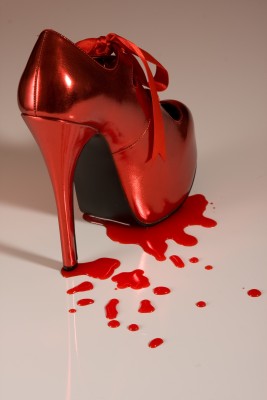
FIRST FRIDAY: Delaney! Iyer! Lovely!


It's First Friday! The day three talented authors give their take on a single photo in 150 words or less.
DELANEY


  The shoes called me through the store window, whispering my sister’s party was tonight, reminding me of that cute guy who never noticed me. I didn’t stand out at parties, and he always looked over my head, not down at me. I wanted him to notice me. What did I have to lose if I bought the shoes? Just half a month’s paycheck and possibly my balance. It was worth it.
  I looked amazing. My mirror told me so. So did the smile on the face of the cute guy as I entered my sister’s apartment. I smiled back and took a step onto her slippery white tile floor. My ankle went one way, the shoe another and my face met the floor. Was that my blood the shoe sat in?  My nose was flowing freely. But the cute guy was picking me up.
  I had been noticed.

IYER
  His nickname was Detective Superman. There’d never been a case he couldn’t crack, until what the media dubbed The Stiletto Murders came along, six vicious slayings ago. The victims were johns, and the murderer’s signature was always the same: a different stiletto posed near the body, blood drizzled around the bottom of the shoe. Neat, clean, no prints, no hairs, no DNA. Nothing but the victim’s unadulterated semen. The shoe, sold in every chain store in the city, offered no clue to the buyer.
  Except this time. This time, she’d left a calling card. For him.
  His heart pounded. Sweat beaded at his hairline, trickled down his back.
  “You all right, Detective?” the first cop on the scene asked. “You look pale.”
  “Fine, fine,” Superman said, sloughing him off. But he wasn’t. Not by a long shot
  He recognized the red stiletto. He’d bought the expensive shoes for her.

LOVELY
  A cherry-red stiletto? Crimey. The blood is dandy. Marley steps in it often enough. But no way would my heroine squash her D-width tootsies in my cover artist’s tribute to foot surgery. What possessed Judy—my early twenties cover artist? Her arches won’t collapse for a few decades. I didn’t expect Judy to read my book, just hoped she’d peruse the synopsis. Sigh.
  Okay, try diplomacy. As authors are pitifully aware, we’re less likely to sway book cover design than President Obama is to gain unanimous Congressional approval—of anything. Guess I could photograph one of my scruffy clodhoppers. While Marley and I are far from twins, we see bunion to bunion on footwear.
FREE today on Amazon!
  Hmmm. Or I could edit. After losing a bet, Marley can be en route to a costume party wearing Madonna breast cones and shiny stilettos when she slips on some blood. Marley would you forgive me?

ABOUT THE AUTHORS

KATHLEEN DELANEY
  Kathleen Delaney writes the Ellen McKenzie mystery series. Dying for a Change introduces Ellen, who’s returned to her career as a real estate agent. Finding a dead body in the closet of the first house you show is a hard way to start. Life doesn’t get any easier for Ellen in Give First Place to Murder,  And Murder for Dessert, and Murder Half Baked.
  Kathleen has just finished the fifth, Murder by Syllabub. She lives in Georgia with a dog and cat and often a couple of grandchildren who love to visit. Or is it the pumpkin/cranberry bread they like?
Polly's Amazon Page

POLLY IYER
  Polly Iyer was born on the coast of Massachusetts. After studying at Massachusetts College of Art and Design in Boston, she traveled to Italy, lived in Atlanta, and now resides in the beautiful Piedmont region of South Carolina in an empty nest house with her husband, a drooling mutt named Max, and Joey, the timid cat. She writes crime fiction that always has a murder or two…or three, characters who cross ethical lines, and a hint of romance.


LINDA LOVELY
At Amazon
  Linda Lovely writes mysteries and romantic thrillers. Her Marley Clark series features a 52-year-old retired military intelligence officer. DEAR KILLER is set in the SC Lowcountry where Marley works as a security guard. NO WAKE ZONE moves to Lake Okoboji, Iowa. Marley will return to the Carolina Coast in book three. Lovely’s newest romantic thriller, FINAL ACCOUNTING, is a set in Atlanta and Jamaica.
  The author is a member of Sisters in Crime, Romance Writers of America, International Thriller Writers, and the South Carolina Writers Workshop. Click on book covers on Lovely’s website—www.lindalovely.com—for ebook and paperback buy links.

Join in! Add your 150-word vision in the comments. We love to read them.

Tuesday, July 17, 2012

How True is Historical Fiction?

SOUTHERN CROSS at Amazon

My guest this week is Tom Isbell, author of Southern Cross, an exciting  tale of double agents, espionage, revenge, and murder set on the S.S. Southern Cross in pre-WWII.
Historical fiction blends the reality of history with the make-believe world of the characters and plot. How true to history should historical fiction be? I spend a good deal of time researching the timeline before I start writing a story. However, the historical part of the story shouldn’t overshadow the plot. The reader isn’t looking for a history lesson. Too much detail pulls the reader out of the story. A friend of mine once said, “It’s fiction, just make it up.” I don’t agree. In order for a novel to be believable, the bits and pieces of history woven into the story must also be believable, and above all correct.
I was well into writing my second novel, Icarus Plot, when I discovered that one third of the town had burned down during the time period of my story. People lost everything and were forced to live in army tents while the town rebuilt. The area was placed under martial law. All of this complicated my life as a writer, but I could not ignore the fire. It was part of the town’s history. I couldn’t change the timeline of the story since it flowed into my next book. After more research, I found some photographs of the fire and also determined the cause of the fire was unknown. This fact presented an opportunity to blend history with fiction while furthering the plot. I wrote two chapters into the book showing how the fire started and how it affected my characters. The fire became an integral part of the plot.
In another instance, I found myself writing a history lesson; showing how much I knew about the history surrounding the time. I chopped two thousand words from a story. The historical facts were interesting to me, but they were not furthering the plot. I would have lost the reader.
So, how true to history should historical fiction be? In the context of fiction, doses of historical fact should remain subtly in the background and not call attention to themselves.

About T. C. Isbell
Like many authors, I started writing in high school. In the sixties and seventies I wrote short stories and poems influenced by those turbulent times. During the eighties, I wrote articles for The Rodder's Bulletin, a monthly newspaper for car enthusiasts. Retirement has given me time to pursue my passion for writing. Southern Cross is the first in a series of historical thrillers set in the period just before the United States officially enters World War II.  It is available through Amazon and Barnes & Noble. Icarus Plot, the second book in the series, is a work in progress.
I am a member of the Pacific Northwest Writers Association and International Thriller Writers (ITW).

Links

Monday, May 21, 2012

That Moment Called Murder


Buy at Amazon or Kindle

Mystery author Faye Tollison is my guest today. Faye is the author of To Tell the Truth and the soon-to-be-released The Bible Murder.

There are many ways to lay out your murder, but I have two that I particularly like to use. They work for me; and as writers, we do tend to like what works.
If you have a murder scene that moves quickly, it would best serve that scene if you build up the scenes prior to it slowly, increasing the suspense and the pace as you get closer and reaching the peak at the moment of murder. The idea is to stretch it out and keep your reader on edge and then moving the actual murder quickly.
The method I used in To Tell the Truth was to build up the scenes prior to the murder scene quickly and then lengthen the actual murder scene slowly, building the suspense up to the climatic moment. When Ken (the antagonist) pulled the gun on Anna (the protagonist), I made the scene go fairly slow to give the reader a sense of the emotion he was feeling. Then when Anna was trying to get the gun from him, the scene sped up, and it moved quickly. But when Anna finally got the gun in her hands, I slowed things down to a very slow pace. Anna needed that time to think about what she was doing. I had her become somewhat mesmerized by the drop of blood rolling down to his upper lip as he pleaded with her; and then the drop of blood stopped and just sat there, not moving any further, building the suspense as the reader waited, possibly even hoping, for her to pull the trigger. Then things began to move fast as John (the cop) moved to stop her from shooting Ken and the gun goes off, Ken falling to his knees and then to the floor.
As you notice, I wrote the scene in a crescendo of slow, fast, slow, and then fast pacing. This method will keep your readers interested and wanting more. Tease them, then back away, and then tease them some more until you reach that moment of murder. Do not give it to them too fast or too slow but in waves of both.
Whether you are writing a mystery or a suspense story, suspense is the key to your murder scene. Even though there are other means of building suspense, pacing still plays a major part in it.
Faye M. Tollison
Author of: To Tell the Truth
Upcoming books: The Bible Murder
            Sarah’s Secret
Member of: Sisters in Crime
            Writers on the Move
            Books in Sync
_______________________


To Tell the Truth
Anna Kacey had faced many difficult situations in her life and had carried some heavy responsibilities. When she met Senator Kenneth Levall, her world soared. At least until it collapsed.
     Undercover cop, Detective John Mentz, came into her life and fell deeply in love with her. He gave her reason to question her relationship with the senator, who he was investigating for drug trafficking.
     But as strong a woman as Anna was, she had to dig deep to find the strength to endure what followed:  the murder of her sister, the destruction of her life, and lastly facing a courtroom full of people, a judge, and a jury in an effort to save the man she really loved. He had confessed to the murder of the senator in order to protect Anna from being charged with the murder.
     It was now time for her to stand up and tell the truth.
___________________

About Faye
Faye M. Tollison has been writing since she was a teenager and has loved mysteries for as long as she can remember. After 27 years in the medical field, she decided to devote herself to writing her own mystery.
She has written several articles on writing, which were published in The Quill, a newsletter for the South Carolina Writers Workshop, and in The Printed Matters, a newsletter for the local chapter for the SCWW. She also had a short story published  in Catfish Stew, an anthology published by the SCWW. As a member of the SCWW, she wrote numerous critiques, which were also published in the Printed Matters. In May of 2011 Faye finished and self-published her first novel, which is a romantic suspense. She is also a member of Sisters In Crime.
Faye lives in the upstate of South Carolina with her three cats and is presently working on her second and third books.


Monday, April 9, 2012

The Importance of Finding Your Writing Group

Bridle Path Press
Marni Graff, author of the Nora Tierney mysteries, is my guest this week.
Writing is such a solitary process that it might seem counter-productive to stress joining a writing group. It’s easy to buy into the myth of the lone writer in his garret, staring at that blank page. There’s also no question that being a writer means spending time alone with your thoughts and is an essential part of the creative process. Writers need time to do research or write drafts, to imagine characters or plot lines, and to revise and polish.
But when a writer becomes locked into his solitude, he loses the ability to connect, the very thing he wants to do with his readers. Other artistic groups don’t hesitate to use the sustaining power of group work: musicians jam, painters work in schools, dancers train side by side in studios.
I’m enthusiastic about joining some kind of writing group based on my own experience, and these groups exist in all kinds of forms, from those which meet physically once a week or month, to others who exist in only cyber-space and exchange pages via email. My own writing group meets yearly in June, after reading each other's novel drafts during May. Each author gets her entire work read and looked at by four other writers whose opinions we’ve come to value. I also run a local group that meets every four to six weeks and we read out loud pages from our works in progress. This is an excellent device for gaining experience reading in front of an audience, while it lets you hear the rhythm of your prose.
At Amazon
But back to those reasons for joining a group: Being a part of a writing community will allow you to amp up your inspiration with a built-in audience for your work. You’ll have the added incentive of a self-imposed deadline for bringing pages to your group when you know they’re waiting to read them. And your group will empower you to travel that long road between your concept for an initial idea and bringing that piece to completion.
One final word on feedback. It’s critical that your group know how to give feedback that is helpful to one another. A list of negatives isn’t helpful to anyone. “I don’t like violent scenes” won’t help the guy who’s writing an action thriller. But if your group can show him what is getting in the way of telling his story well, the idea of the violence you abhor becomes less important as the storytelling improves. Once you are part of a writing group who have learned how to give good feedback, you will use that group to improve your own craft. By editing the work of your fellow authors, you’ll be learning how to edit yourself. By listening to the story others tell and how they do it, you will learn how to effectively tell the story you want to tell.
__________________
Marni Graff is the author of the Nora Tierney mystery series, set in the UK. The Blue Virgin is set in Oxford and introduces Nora, an American writer living in England. She becomes involved in a murder investigation to clear her best friend as a suspect, to the chagrin of DI Declan Barnes. The Green Remains follows Nora’s move to Cumbria where she’s awaiting the publication of her first children’s book and the birth of her first child. When Nora stumbles across the corpse at the edge of Lake Windermere, she realizes she recognizes the dead man. Then her friend and illustrator, Simon Ramsey, is implicated in the murder of the heir to Clarendon Hall, and Nora swings into sleuth mode.
Graff is also co-author of Writing in a Changing World, a primer on writing groups and critique techniques. She writes a weekly mystery review at www.auntiemwrites.wordpress.com. A member of Sisters in Crime, Graff runs the NC Writers Read program in Belhaven. She has also published poetry, and her creative nonfiction has most recently appeared in Southern Women’s Review. Her books can be bought at Amazon.com or at www.bridlepathpress.com.