Monday, October 31, 2011

Your Embassy Invitation

Come for a tour of the glittering--and gritty--world of foreign embassies with this week's guest, William S. Shepard. William is the author of the diplomatic mysteries featuring Robbie Cutler.
 Buy Murder on the Danube
     Last Sunday we were having luncheon with some old friends who were celebrating their wedding anniversary. At my table was their eldest grandson, just out of college with an interest in international business, and no job. I mentioned to him the State Department’s Foreign Service, and the fact that they are hiring new economic officers, following a rigorous set of written and oral exams. His eyes lit up – he had never really considered this career option. Perhaps you have a grandson, or a brother, niece, or son or daughter in college who might be intrigued. My own interest was started by a book on diplomacy that I chanced upon while rummaging through books in our high school library. It looked like a fabulous career. In many respects, it still does.
     Have you ever wondered if diplomacy is all glittering Cary Grant or Sean Connery with no down to earth Dennis Farina or Sylvester Stallone? Would you be intrigued by an invitation to an Embassy reception? And have you ever wondered how diplomats are chosen, and what they do?
     The classic, cynical answer to the last question was phrased by an English statesman many years ago: “A diplomat is an honest man who is sent abroad to lie for his country.” However, my experience, gleaned from negotiating a treaty with a communist government, is that the farther apart your country is politically from the host government overseas, the greater the need for candor and honesty. 
     This all comes up because I took the good advice that every writer is given – write about what you know.  And my career was in the Foreign Service as a career diplomat, or Foreign Service Officer (FSO).
 Buy Vintage Murder
     My new series of “diplomatic mysteries” explore this world. In the first, “Vintage Murder,” a thirtyish career diplomat, Robbie Cutler, is assigned as Consul in Bordeaux.  He is brought into a murder and blackmail scheme on the part of a terrorist organization, the Basque ETA (a real group which operates on the border between France and Spain). In the sequel, “Murder On The Danube,” Robbie is reassigned to the American Embassy in Budapest as Political Officer. He must sort out the murder of a prominent visiting American, against the background of the Hungarian Revolution years ago.
     The diplomatic world is pictured here. Robbie holds a staff meeting in Bordeaux, and participates both in an Embassy conference at Paris (very like the ones I attended), and an Ambassadorial dinner party for visiting Senators. In Budapest he briefs a visiting Congressman, shares notes with political officer colleagues from friendly embassies, and takes us inside an Embassy staff meeting. All of this is the actual diplomatic world at work. It is, however, projected upon the need to solve crimes, Robbie’s specialty. And to do so, Robbie must dig deep behind the masks of what people are saying to get to the truth – as a competent diplomat or detective must do. Robbie Cutler, aided by his fiancĂ©e Sylvie Marceau, must do both.
     I suppose at one time, diplomacy was like the elegant popular image.  That began to fade in Viet-Nam, when FSOs were assigned out of the Embassy and into the countryside. That is becoming more the norm than the exception, as FSOs in current war-torn areas perform civil affairs work. The days of “The Ugly American,” when diplomats did not speak the local language, are long since past. (That film, by the way, inspired the establishment of our Foreign Service Institute, with intensive training in every conceivable foreign language.)
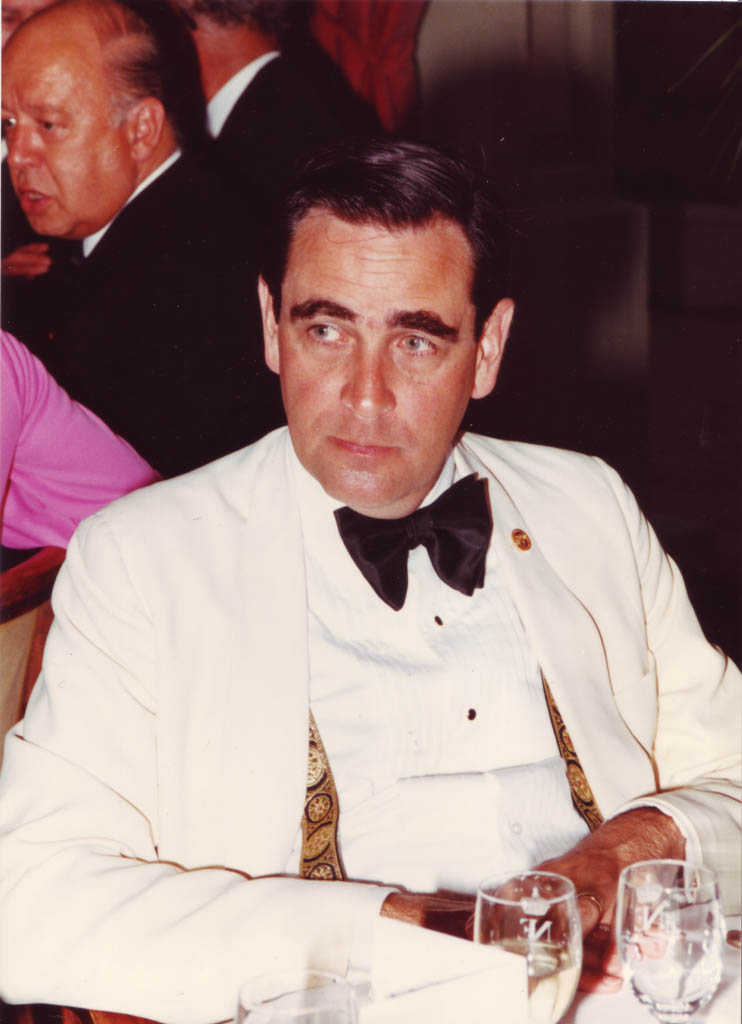
     Don’t worry. There are still glittering Embassy receptions, and Robbie Cutler will find lots of scope for his investigations at his next assignment. And the diplomatic world despite the surface glitter is a very real and perilous one, as Robbie will find out as he climbs the career ladder of diplomacy. Fortunately, his wife will then be able to interpret for him with a keen insight what people are trying to hide.  She may even solve a murder or two that he hadn’t suspected!
_________________
About William S. Shepard

Now residents of Maryland’s Eastern Shore, the Shepards enjoy visits from their daughters and granddaughters, fine and moderate weather, ocean swims at Assateague, Chesapeake Bay crabs, and the company of Rajah and Rani, their two rescued cats.
Prize winning mystery writer William S. Shepard is the creator of a new genre, the diplomatic mystery, whose plots are set in American Embassies overseas. That mirrors Shepard’s own career in the Foreign Service of the United States, during which he served in Singapore, Saigon, Budapest, Athens and Bordeaux, in addition to five Washington tours of duty.
His books explore this rich, insider background into the world of high stakes diplomacy and government. He evokes his last Foreign Service post, Consul General in Bordeaux, in Vintage Murder, the first of the series of four “diplomatic mysteries.” The second, Murder On The Danube, now also available on Kindle, mines his knowledge of Hungary and the 1956 Revolution. In Murder In Dordogne Robbie Cutler, his main character, is just married, but their honeymoon in the scenic southwest of France is interrupted by murders. The most recent of the series, The Saladin Affair, has Cutler transferred to work for the Secretary of State. Like the author, Cutler arranges trips on Air Force Two – now enlivened by serial Al Qaeda attempts to assassinate the Secretary of State.

Friday, October 28, 2011

When does it become formulaic?

I've often heard the term used in a derogatory tone, and to be certain about its  meaning, I looked it up. The best explanation came from ArticleWorld.org .  Ah, a standard set of plots, characters, and so on. Yes, I've read many. I still dislike the word. It's in the same category as "literary." Literary is often used to imply that other styles of writing are somehow lacking in quality or generally unworthy.  Then again, used by genre writers, "literary" may mean plotless. (I've heard it described as self-absorbed and about as exciting as watching paint dry.) We seem to need something or someone to look down upon--one of our less desirable human traits.
Considering the number of books on the market and how many I read, I'm bound to recognize elements of the story. So does that make the book formulaic?  Perhaps, but that doesn’t necessarily cause me to reject it. What allows me to overlook the commonplace, what sets many of them apart, is the writing. If it flows well and the characters are believable and likeable—or at least interesting—I'm halfway there. Sometimes the plot falls apart for me—too many convenient events that don't tie in to the story, as if hurled from the heavens by a capricious diety solely to cause problems. Still, I've read many a good book that others consider formulaic (always described with a little disdain).
How far down into the story do you have to go to decide whether a story is formulaic? Take this as an example: Boy meets girl, boy loses girl, crisis occurs, boy gets girl. There's a formula that's been used more than once, but is it bad? The treatment of the story, the setting, and the characters can make it all seem new—something to read with pleasure and enthusiasm. You could go down another layer and see if there are still tried and true (or tired and overworked) secondary characters and situations. But it can still be fun to read. It depends on the pacing, the way the story unfolds, and how much we care about the characters.
When does it become a formula?
For me, the biggest challenge to my reading pleasure comes in the second phase—boy loses girl. The conflict is often artificial and contrived, but I think it's that old round hole thing—writers are forced to shove and squeeze their oddly shaped stories into that rigid mold. If it's formulaic, who can blame them? How many ways can you create enough conflict to keep apart otherwise sensible people who are attracted to each other? Personally, I'd like to see a little flexibility in that one. A little more credibility and realism would be a welcome change. Shakespeare handled it well, but I like happy endings. How often can a theme be used before it becomes trite? Is frequency the only measure?
I'll admit some books are so familiar that I can't remember whether I've read them before. I don't usually finish them. But I find "formulaic" applied to many that seem quite good to me. I'd have to go several layers down to reject a book because it's been done to often. Maybe I just don't have a discerning eye.
Every genre and just as many mainstream and literary stories follow some basic  theme or idea. Does it bother you? Do you see it? Do you look for something totally different? Do you consider many books formulaic?

Monday, October 24, 2011

Writing and Authors and Lawyers, Oh My!

Una Tiers is my guest this week. Her debut novel, Judge vs. Nuts, will be released soon by Echelon Press.
Una Tiers has written a story about a lawyer in Chicago, a goldfish and a dead judge.  The protagonist, Fiona Gavelle, blithely plods along in her first probate case until she learns that her client may have been murdered.  Her efforts set out to prove that his death was accidental.  While she learns about the practice of law, she will introduce you to her mostly lawyer friends, her favorite aunt and only reveal a glimpse of her personal life, which is in shambles. 
Judge vs. Nuts is a hilariously funny take on judges, but also a scathing indictment of judicial politics.  Lawyer Fiona Gavelle narrates with a wonderful, self-deprecating wit, as she goes about unraveling the murder of a Cook County judge. 
   --Barbara D'Amato, author of Other Eyes.

In Una's words . . .  
By day I’m a lawyer and at night I fight crime.  Despite the seeming differences, both of my roles rely on writing and editing.  Whether it’s a court pleading, opening statement, a letter, will or loophole, I write for accuracy and one meaning only.  When the sun sets, I look for double meanings, humor, chilling sentences and plot twists.
My bottom line is that I teach people about their rights and options. 
My mystery writing didn’t start out as a surreptitious teaching tool; it started with a need to reduce stress after a particularly awful day in court.  From time to time I added a victim and did more editing than writing.  It is really fun.
After meeting a slew of mystery writers, I noticed that I was introduced to the day to day life of a librarian, a food critic, a minister’s family, a several detectives and more. 
Given the opportunity, I invite you to meet one attorney on a day to day basis.  We’ll untangle a murder along the way and slip in a great deal of information about the legal system.  Thank you to my sight unseen writing buddy, Ellis Vidler, for inviting me to her magnificent blog.
  __________________________
About Una

Una Tiers (pen name) is an attorney in Chicago, Illinois.  She writes daily, wills, trusts, court documents and of course, threatening letters.  For years, her creative writing was on hold.  After one nasty day in court, she wrote a short story, murdering the bane of her existence.  It made her laugh and happy. Periodically chapters were added to the story and she laughed some more.  After meeting some amazing authors, Una came to regard fiction writing as a way to teach about the law.   The result is Judge vs. Nuts.   Available at Amazon.com in early 2012. 
 For more information, visit her website:  http://www.unatiers.com/
Connect with her on Facebook  and Linkedin.

Saturday, October 22, 2011

Sisters in Crime 25th Anniversary

Since I have no real blog for today, I'm posting pictures from the Upstate SC Chapter of Sisters in Crime. They're from our recent celebration, a panel discussion and refreshments at the Easley Library. Joyce Lavene kindly took most of the pictures for us. She and her husband, Jim, came from the Charlotte area to help us celebrate. Their 60th book will be out next month. The Lavenes have been guest speakers several times and are always helpful and fun. 


Kathleen Delaney

Maryn Sinclair

Linda Lovely

Faye Tollison

Steve Brown

Tuesday, October 18, 2011

Lisa Black, author of the Theresa MacLean mysteries, is my guest today. She's uniquely qualifed to write these books and, according to Tess Gerritsen, "She is, quite simply, one of the best storytellers around."
Defensive Wounds grew out of the unique and usually frustrating relationship between cops and attorneys. Even though I’m not a cop—I’m a forensic specialist—the same factors apply. From watching Law and Order you would think they we’re the best of friends, that attorneys are always treating us to lunch at fancy restaurants—hah! Not even McDonald’s. We function in different worlds. We function with different mindsets. I look at the situation and think, what can I learn from this evidence? A cop thinks, what convinces me that this suspect is the guy who did it? A lawyer thinks, how can I convince the jury that this is what happened? It sounds like all those processes should work together, and ideally they should. But even when they do, that does not mean we all get along like the Bobbsey Twins.
Defense attorneys especially are usually in the position of needing to make me look like an idiot. Even if I don’t have anything to present that implicates their client, they need to make the entire police department look utterly incompetent and unfortunately that includes me. They can ask umpteen million questions about minor point of procedure and I’m not allowed to say: do you realize this has absolutely nothing to do with whether your client did it or not so you’ve just wasted twenty minutes of the jury’s time? I’m not allowed to do anything but answer questions. But make no mistake about it, no matter what side of the courtroom an attorney stands on, if you are saying something that helps their case, they like you. You’re a good guy. If you’re saying something that doesn’t help their case, you’re an idiot who needs to be dealt with. This is the adversarial system of law and it’s a good one. But when it’s you in the witness box, it’s not a comfortable one, and that’s what I tried to bring out in Defensive Wounds.
The book begins with a murder at a defense attorney convention in the beautiful Ritz-Carlton hotel located in Cleveland’s most recognizable landmark—the Terminal Tower, with its 700 foot high observation deck.
Theresa’s daughter Rachael is out of college for the summer and working there at the front desk, in fact she’s the first to alert Theresa to the homicide. This little coincidence begins to complicate Theresa’s life as she realizes that her daughter is falling for a handsome coworker—and then finds out how this boy once stood trial for a brutal crime. In fact, the first victim had been his attorney. But the attorney also had a host of enemies, many of whom are also attending this convention.
Theresa has the walls closing in from every direction—she is trying to work under the scrutiny of people who will use everything she says or does against her in the court of law, if possible. Her crime scene is a hotel, littered with the microscopic debris of past guests that may or may not be relevant to the murder. Her daughter might be falling under the sway of a very dangerous man.
And the killer is not yet finished.
__________________

Lisa Black’s fourth book, Defensive Wounds, was released by Harper Collins on September 27. Forensic scientist Theresa MacLean battles a serial killer operating at an attorney’s convention. Lisa is a full time latent print examiner and CSI for a police department in Florida. 

Visit Lisa at her blog or website for more information.

Friday, October 14, 2011

When Characters Won't Cooperate

The romance is gone—actually, it never was. What do you do when the two main characters in your romantic suspense refuse to go beyond "like"? I've tried forcing them, but the scenes are artificial and flat. Somehow they got to be friends, but the chemistry isn't there. No zing. Also, this book is too short. And I don't like the ending I had planned. I'm not sure where it all went wrong, but it did. If it doesn't interest me, why would it interest anyone else? When I start looking at the state of the house instead of wanting to write, I know I have a serious problem.

Mr. Very Right

The secondary characters work. It's the hero and heroine who are lacking. Yesterday I realized part of the length problem is because there's been no romance along the way, something that usually happens over a number of scenes. Ramona Long triggered that thought by asking if the romance overwhelmed the suspense. Nooooo, but it made me think. It's a good question. What do you ask if your story's not working? I don't want to trash 190 pages and other characters I really love. How do you figure it out?

Mr. Too Wrong?

The right Mr. Wrong? 
So what to do? I've tried making Mr. So-So into Mr. Right, but it didn't work. She keeps taking off on her own. After much nail-biting and procrastinating, I think I got it. He's about to become Mr. Wrong. I need to research how far I can go with a federal prosecutor, but if necessary, he'll have to drop out and find a new job. He's undergoing a personality transplant as I write this. She has to change a little too. Then maybe the ending will work itself out. We shall see, but I have hope.

Monday, October 10, 2011

Coincidence or Conflict: I had to Choose

Donnell Ann Bell is my guest today. Her debut mystery, The Past Came Hunting, has just been released in print and eBook. What a great premise!
If you’ve been writing as long as I have, chances are you’ve received your share of rejections.  There are myriad reasons a book is rejected:  Pacing’s off, too much backstory, failure to hone one’s craft, the story doesn’t resonate with the editor or agent, lack of conflict, the story feels contrived, it’s cloudy, the agent doesn’t care for her new haircut…
In my case, my book was rejected because the agent or editor couldn’t buy a coincidence.  Which for me was a little hard to accept because I’ve been the recipient of coincidence my entire life.
When I was in grade school my mother took my little sister, my friend and me to the movies.  Charlene and I coerced my mom into letting us watch the show from the balcony, and eventually Mom relented.  Excited, my schoolmate and I gathered our popcorn and soda, went up to the second floor like the big kids, and while tugging off my coat, I knocked my soda off the railing.  On the way home, my sister cried that some idiot above her had splattered her with a drink.  Oops.
In fourth grade I had my appendix removed.  A nurse entered my room and said that a boy around my age had been severely burnt in a fire and wondered if I might be willing to spend some time with him.  I agreed.  I dated that boy my sophomore year in high school.  At a dance I put my arms around him, and felt the scars through his shirt.  He explained he’d been in a fire as a boy.  When I asked how it happened, we were both amazed as we remembered our talks in the hospital.    
Last February when my husband and I went to Key West, my cousin and her significant other gave us a tour of the island.  After she took us back to our bungalow, she said, “You’re staying here?”  Worried we were staying in a disreputable place, I replied, “So far.  Why? What’s wrong?”  “Nothing,” she replied.  “It’s just that this is the same bungalow your mother stayed in with your brother when your dad shipped off to Okinawa 55 years earlier.”
My future daughter in law and I were born in the same hospital in Lubbock, Texas.  She lives in Fort Worth, I live in Colorado Springs.  An innocent conversation about where we were born confirmed we were both born at St. Mary’s Hospital.  I ask you:  What are the odds?
As you can see, I’m no stranger to coincidence, which brings me to the subject of this blog.  During my stint at the Citizen’s Academy, I asked some deputies what’s the worst thing that could happen during the course of their career?  Without hesitation, one deputy replied, if an ex-con moved next door to me. 
I’d been plotting THE PAST CAME HUNTING for some time by then, and that comment provided the ideal solution for me.  I needed a conflict for my protagonists, one an ex-con, the other a police lieutenant.  I heaped on additional conflict by adding their teenage boys to the scenario and making them inseparable.  Contrived?  Maybe.  But I think I made it work.  Further, if I would have moved Melanie down the street or into a different neighborhood, I would have lessened the conflict and it wouldn’t have been the same story.
I simply had to choose--conflict or coincidence.  For me, it made sense to pick the latter.
Now, I have a question for you.  What’s the biggest coincidence that has happened to you?  Have you put one in your stories, or do you avoid coincidence at all cost?  I’m giving away THE PAST CAME HUNTING to one commenter today on Ellis’s blog who lets me know I’m not alone or that I should have moved Melanie to say…Tahiti. ;)
Donnell Ann Bell is a two-time Golden Heart Finalist and a debut novelist for Bell Bridge Books.  To learn more about Bell Bridge Books visit http://www.bellebooks.com/ or to learn more about Donnell, check out her website at http://www.donnellannbell.com/