Friday, October 30, 2015

Haunting Refrain, Audible.com
This is an excerpt from Haunting Refrain, suspense with a little romance and a touch of paranormal. 

 Martin looked sick. “Do you have any feeling about the person strangling her? Was it someone she knows?”
“A man, I think. I couldn't see, but I have an impression of size and strength that suggests a man. That's all.” She looked up at him. “Please tell me what this is about.”
“Only one more question. Could you tell what time of day it was?”
“What does that matter?” she asked. “It was dark. Night. Now whose is it?”
He took a deep breath and held out the card. “The sweatband belongs to Kelly Landrum.”
Kate reached for the card, wondering where she’d heard the name. “Kelly Landrum? Who's—”
“She's the girl who's missing!” Venice cried, catching the cup as it slipped from Kate's hands. She took a quick sip and choked.
Kate snatched the card, needing to see it for herself. She read the name. Kelly Landrum. A spot like a teardrop blurred the blue ink. An omen? Please, don’t let it be true.
“Yes, she's the student who's been missing for four days.” Martin kept his gaze on Kate's drawn face. “Her picture is on every newspaper and television screen in South Carolina. Someone found her car here on the campus. The police have been all over the place since then. We should call them, Kate.”
“No! I haven't seen anything that could help them, and I'm not touching that thing again.” Kate retreated into the chair, pulled her knees up under her chin, and wrapped her skirt around her legs, holding herself tightly. If she didn’t, she might fall apart—the image was so strong, so immediate. She touched her throat. And if it was true . . .

REVIEWS
"Quirky, engaging characters .... Both Venice and Kate are charmers!" -- Romantic Times 
"The interaction between Kate and her friend, Venice, is priceless." A. McGraw
"...this first novel [is] a good choice for readers who like a bit of the paranormal in their mysteries." -- Library Journal

Saturday, October 3, 2015

What makes memorable characters?

Jack Nicholson, always memorable
Why do some stories touch us so much that we return to them and the characters again and again? Why do the characters come back to visit our dreams many times?
Maybe part of it is the way each character’s story resolves itself—not necessarily happily but in a just and satisfying way. Sometimes the resolution isn’t what we expect, but if it seems to fit, if it’s what the character has earned, we’re pleased.
In my favorite books and movies, the characters grew. Each one developed in some way that made us cheer. Not all the characters were likable, but they were interesting and each elicited an emotional response. We cared. 
The point is that we should try to do the same thing in our stories. But how?
A book that never lost its appeal
We need to give each of our main characters some weakness or undeveloped trait and then impose conflict and circumstances that force the character to react. From those reactions, the characters should learn, gain confidence, and move along their path. This doesn’t have to be a positive path, but if it’s your protagonist, he or she will probably then need to overcome the negative aspects—unlikely in a short story because it takes time to show so much change.
Placing the story in a foreign or culturally different setting imposes change and provides opportunities for the character to react according to her personality and outlook. “Foreign” could be anything different from the norm. An egocentric, in-charge character might become a patient in a hospital. A timid, indecisive soul could find himself in charge of a group of children in a hostile environment. Those are extreme examples, but forced change is a good way to do it. 

Amazon
In Cold Comfort, Claire is an ordinary woman who becomes a killer’s target, forcing her to move outside—way outside—her comfort zone. Riley, because of a personal failure, hates working with women, but a debt of honor forces him to help Claire.

There are many ways to do these things, limited only by our imagination. Do you consciously think about making your character grow? How did you do it? What vehicles or devices have you used?

Saturday, September 19, 2015

Writing Action Scenes

I
Grizzlies play fight, San Francisco Zoo
n an action scene, one in which the emotions are high and the reader is on the edge of the seat, the mood is tense, the writing tight. Use all the senses, the coppery taste of blood, the cold sting of the rain, the smell of old fish. Limit the number of adjectives (descriptive words). Cut any that aren’t absolutely necessary. Find strong verbs and let them do the work. Avoid adverbs ( –ly words).


The pacing in an action scene is fast. There’s no room for background or description, which will slow the action. Save these things for slower scenes and when you want to give the reader a little time to catch her breath.

In action, every word must count. Vary the length of your sentences, using short, terse statements and fragments mixed with longer sentences. Keep paragraphs short. Eliminate “and” as much as possible. Don’t use words that dilute the meaning, such as “almost,” “seemed,” and “nearly.” Make it hard and fast; give it some punch.

Saturday, September 12, 2015

Oh, those flying body parts!

Have you ever heard the term “flying body parts”? Flying body parts occur when the parts act independently of the person.

Most of us are guilty of occasionally writing them into our work. They do slip in, especially with eyes. Her eyes swept the room. We all know what that means, but such statements conjure up bizarre pictures and can take the reader right out of the story. Do you see the eyes floating around, controlling the broom? Magic of an unintended kind!

If the person (as opposed to the body part) performs the action, the logic doesn’t jar the reader so much. If body parts, usually hands, feet, or eyes, perform the action, they can create a weird image of the part acting independently of the person. They’re often called flying body parts. 

Examples:
Her eyes flew upward to the crows. Better: She glanced upward at the crows.


His foot kicked the ball. Better: He kicked the ball.

Her hand reached for his. Better: She reached for his hand.

Even though readers know what the sentence means, these images can yank them out of the story. Read those body part lines carefully to see if they convey the correct image.

Sometimes, even when the person performs the action, the verb doesn’t work. She shot her eyes at him. It makes the reader wonder how, with a sling shot? She tossed her hand in the air, dismissing him. She can toss her hair but not her hand, or she could wave her hand.


Have you ever been guilty? Have any good examples to share?

Tuesday, January 6, 2015

Winter Hummingbird

Cold weather is here and the lights that warm our hummingbird feeder failed. We made it fall a year ago when Thumbelina, a female rufous hummingbird, first showed up. She came every day from November 7 through April 11, then moved on to her summer breeding grounds, possibly in the Northwest. Rufous Hummers have been seen in summer from Oregon to Alaska. 
Map from Cornell's site

They're usually on the West Coast all year, so she's a real wanderer. More and more are seen in the East in winter. They've adapted pretty well to the cold weather.  

When it’s above freezing, she eats insects. We often see her darting back and forth, usually in our holly tree. We know it’s Thumbs because nothing else can change direction in mid flight that way.


They've adapted pretty well to the cold weather.  When it’s above freezing, she eats insects. We often see her darting back and forth, usually in our holly tree. We know it’s Thumbs because nothing else can change direction in mid flight that way.

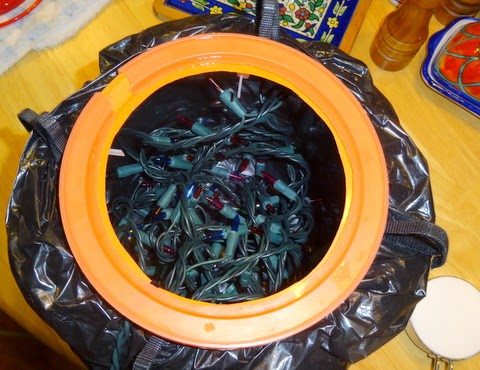
Christmas tree lights in a plastic tub


The temperature is going down to 15 degrees this week, so we dug out another set of lights and re-rigged her heated feeder. Appropriate for January 6 and the Feast of Lights, don't you think? This is also Epiphany, when the wise men visited the babe in the manger.

Thumbelina, Nov 13
We’ve been watching for her and she came back November 13. Here she was on that bright, sunny day. We didn't attach the lighted container until the first freeze.

When the temperature reaches mid forties, we turn it off as the liquid (1 part sugar to 4 parts water) starts to thicken if too warm.
I managed to get a bad picture of her while ago, so she’s doing well.
Thumbs, Jan 6


The lively and entertaining Shehanne Moore, author of some excellent steamy historical romances, nominated me for the Drum Beat Award. Visit Shehanne's blog! She's funny, nice, generous, and always interesting. 
“This is an award created by Sue Dreamwalker to pass along to bloggers who are sharing posts which are helping show our empathy, Love and Kindness, or who Highlight injustice who beat their own Drum to bring awareness to the world”.
Drum Beat Award

Monday, January 5, 2015

Renown or renowned?

The misuse of renown and renowned is a common error that makes me cringe.
Example of misuse: “was made into an award-winning TV series starring the renown actor Ian McKellan.”

Renown is a noun meaning fame or high repute, as in "an author of great renown." The adjective, meaning well-known or famous, is renowned. The renowned author . . .

If you can substitute fame, the word is renown. If you can substitute famous, the word is renowned.

Ellis, feeling curmudgeonly

Tuesday, December 16, 2014

Real Neat Blog Award and Giveaway

1. Put the Real Neat Blog Award logo on your blog.
2. Answer 7 questions asked by the person who nominated you. That would be me. 
3. Thank the people who nominated you, linking to their blogs.
4. Nominate any number of bloggers you like, linking to their blogs.
5. Let them know you nominated them (by commenting on their blog etc.)

GIVEAWAY: I’ll send one commenter one of my eBooks—your choice of book and recipient (if you want it to be a gift).

My questions were asked by Shehanne Moore, historical romance author and blogger extraordinaire. Thanks, Shehanne, for including me.

QUESTION 1 Where do most visits to your blog come from? United States, Ukraine, Russia, France, Germany, United Kingdom, Australia, India, Belarus, Canada—in that order. Surprising!

QUESTION 2 What is your favourite sport? Watching. I’m a great watcher. I watch any number of things, such as birds, dogs, horses, figure skating, stars, the sky, and when I have the opportunity, moving water (the sea, lakes, streams, creeks).

QUESTION 3 What is your favourite quote? I have several, but one especially from John Stuart Mill: Bad men need nothing more to compass their ends, than that good men should look on and do nothing.
There are many from Martin Luther King, Jr. Here's one I'm fond of.

QUESTION 4 What was your favourite class when still at school? English. I’ve always loved reading and it was a natural. I also loved art, but I soon learned I was a small fish in a very large pond.

QUESTION 5 Anything you had wished to have learned earlier? To follow my dreams. I wish I’d persisted early on and not let life dictate what I did, at least not to the extent of putting everything on hold for many years.

QUESTION 6 What musical instrument have you tried to play? There was a brief--very brief--stint with a violin. Now I play CDs. Definitely better for me and everyone in hearing distance.

QUESTION 7 What has been a special moment for you? Finally, finally getting Prime Target published. That one was hard, but I loved it. And listening to my granddaughter singing Vivaldi’s “Laudamus Te” (on left) and the Flower Duet from Delibes’s Lakmé. Seeing my grandson in Beauty and the Beast and as the Gatekeeper in The Wiz.


I’m nominating Leslie Ann Sartor, whose interesting blog is http://anindieadventure.blogspot.com/ She’s the author of an adventure series and the star light, star bright romance novels. Check them out; they’re good stories and a lot of fun.