Monday, December 27, 2010

Those Deadly Pronouns

The use of pronouns came up on a list I read. As always, they’re viewed with mixed opinions. My main concern is that the antecedent be clear. I really hate to stop and have to figure it out or wonder who “she” is.

Overuse of proper names is equally distracting. You just have to read your work carefully and make sure it’s clear. If not, look for an interesting way to fix it.
When two or more persons of the same sex are present in a scene, the pronouns are difficult. Try to use descriptions to identify people or use the names more often. The tired waitress, the frazzled customer, the girl. Use dialogue instead of narrative so it’s clear who’s doing what. Review scenes with a number of hes or shes and see if the writing can be made clearer and more vivid at the same time.

Pronouns modify the last stated noun. Example: I found a book in the store. It was old. This sentence means the store was old, not the book, because store was the last stated noun. Use care with pronouns.

Personal pronouns modify the last stated name. Be certain pronouns modify the intended proper noun. Joe and Bill raced around the track. He longed to leave him in the dust. Technically, this means Bill yearned to leave Joe, but the reader may have doubts, and it may not be what the writer intended. Try being a little more creative. Bill’s big Nikes kicked dust in Joe’s face. Joe hated coming in second—he yearned to leave the older boy in the dust, and one day he would. The context makes this clear, even with all the pronouns.

What are your pet peeves on pronouns? Do you have any good examples?

Tuesday, December 21, 2010

Celestial Events? Not.


Eclipse of the Moon, image credit David Lee, NRC--
no, I didnt' see it.

The number of times I’ve left my warm bed at some wee hour to witness a celestial event . . . well, more than I care to count. Last night was typical—solid cloud cover, not a glimpse of the eclipse. My alarm went off at 2 and I grabbed coat, camera, and binoculars and went outside to a starless, moonless fuzzy sky. At about 2:30, without seeing a flicker of anything interesting, I caved. I did get a picture of the sky (lightened as much as Picasa allows) and a shaky picture of my neighbor’s Christmas lights.

Neighbor's Christmas Lights
I’ve spent hours lying on my back in a cemetery, watching clouds in the dark of night. Sometimes all I get is bug bites or frostbite. I am not lucky in these matters. A few years ago, a friend and I drove into the mountains looking for a dark spot to watch the Leonids. We took the inevitable  thermos of hot chocolate, a couple of lap robes, and wandered around till we found a dirt road leading into a dark field. After we’d sat in the car for an hour, a fist knocked on the car window--some guy with a gun over his shoulder wanted to know if we had a problem. After we wiped up the chocolate that went all over the blankets, we explained about the meteor shower (news to him). He seemed skeptical but left, back to his warm bed no doubt. For our sins, we saw lots of clouds. Not a single shooting star.

When my son was small, there was a time with lots of reports of UFOs in the area. He and I got up at two and sat in the back watching for them. We lit three candles, hoping to entice them to our yard, which wasn’t that big—certainly not big enough for the mothership, but we thought maybe a scouting party in a smaller craft might come by. After a while, Johnny suggested food. They might like cookies, he said, only we didn’t have any. All we found were saltine crackers, but he added a glass of tea. The aliens never showed.
My usual view

That was long ago, but I’m an optimist, at least about some things. So I woke my grandchildren and two dogs in the middle of the night, and, miracle of miracles, my husband, and set out on another celestial hunt. It was freezing cold, but we had hot chocolate and blankets, drove into the mountains, and spread out on the ground. We saw maybe three shooting stars.

The most (and possibly only) successful night came when Hale-Bopp passed over the mountains around Clyde. I drove out with my cat in the car (what can I say? I like company), found a dark mountaintop, and waited. And there it was, right on time, right where it was supposed to be. I even have pictures, if I could find them.

Really, the return on investment is out there with sending query letters.
                                                 
So, what are you doing January 3?
The next meteor shower is the Quadrantids on the night of January 3. The shower has a sharp but brief peak, with few meteors on the nights before and after. The Moon is new, so it won’t interfere with the shower’s fireworks.

Name / Date of Peak/ Moon
Quadrantids/ night of January 3/ New
Lyrids/ night of April 21/ Rises after midnight
Eta Aquarids/ night of May 5/ Sets in early evening
Perseids/ night of August 13/ Full
Draconids/ night of October 8/ Sets around midnight
Orionids/ night of October 21/ Rises after midnight
Leonids/ night of November 17/ Rises around midnight
Geminids/ night of December 13/ Just past full

NOTES These are approximate times for the Lower 48 states; actual shower times can vary. Bright moonlight makes it difficult to see all but the brightest meteors.

Friday, November 26, 2010

Rules or No Rules?

A few truths pop up in most commercial fiction. Does that make it formulaic? I don’t think so. People read fiction for entertainment or escape. Happily-ever-afters make me happy. Life has enough tragedies—I don’t need any more. Crime fiction does have some bad scenes and a few murders; but the main characters usually win in the end, and the bad guys get what they deserve, so it’s satisfying.
What about the “rules”? Don’t kill children or dogs, at least not if they’re major characters, and definitely not “on-screen.” That’s an understandable guideline, one that suits me. A child murder in backstory is usually acceptable though, something that happened before the main story begins and is only referred to, not seen.
Rules are only guidelines, and they shouldn’t stifle creativity. Sometimes they even make you stretch to come up with an interesting twist on an old theme.
Rules can always be broken, and it’s easy to come up with successful examples, but seriously breaking them makes the book a harder sell, particularly if you’re not an established writer. The rules are there for a reason—they’re proven to make books more interesting and help them sell. But it’s still tough sometimes.
What do you think? Do you find them constraining? Do you ignore them or try to work with them?

Saturday, November 6, 2010

Clowns—no, it’s not about politics

It’s about the papier-mâché clowns I used to make. Most of them became lamps, and they all found homes. Papier-mâché means chewed paper, but I wasn’t that authentic. They were entirely handmade though. I made coat-hanger frames, tore newspaper into small pieces, and soaked it in a mixture of flour, water, and Elmer’s glue. Each clown took close to 40 hours to make , counting the drying time. The clothes were paper too. The oven was always on and steaming. Definitely a winter event. But it was fun. It did destroy the kitchen while I was doing it though. I can’t even write on a computer and be neat. My kitchen table was under this mess for weeks at a time.
The clowns were unique and most represented something or were doing something, such as napping. One was a boxer, one a cowboy, a baseball player, but all had clown faces and feet.
Later I tried using dolls for the base to save time, but they weren’t as interesting.
All this was many years ago, when our son was in middle school. One day he asked if I could pretend to be normal for a while and bake cookies or something that smelled good instead of paper. Since then we’ve come to appreciate that neither of us will ever be “normal.” He’s a musician, so he can’t say much.  

From now until Thanksgiving, I doubt if I’ll get any writing done. Maybe I’ll post about cooking—it’s better than cleaning.  I’d like to paint a couple of rooms, but I doubt I’ll have time. I don’t want just plain color, I want faux finishes. Nothing’s ever simple.

What do you do? Do you cultivate messy, impractical activities?

Saturday, October 30, 2010

Coal in the Pudding

As writers, we know far more than we tell, but there’s always a temptation to use everything you’ve researched. When we succumb, it’s like finding lump of coal in the pudding—the big action scene is at hand, our pulse is racing, and whoa! We stop to watch the heroine prepare her hot air balloon for the escape from the rooftop, and we’re treated to every detail. Ah, yes, you think. The writer spent an afternoon researching with a balloonist and made note of every tuck and fold. And here it all is—every tuck and fold. The story comes to a dead halt, or maybe there’s a brief mention of something important—which you’ll probably miss because by then you’re skimming past this fascinating scene. If you’re still reading at all.

Think before you let the research take over. Make sure the information is something the reader needs to know. Bring it in when it’s pertinent to what is happening in the plot. Mix it with action. If it doesn’t move the story forward, sit on your hands until the urge to tell all has passed.

And then there’s necessary information and how to present it. Although you can let a character explain what the reader needs to know through dialogue or thought, this too can be heavy-handed. There must be a valid reason for the character to explain.

Dave answered the door. “Hello, my daughter. How’s the architect business today?” 

A little obvious, don’t you think? But it did tell us their relationship and that she’s an architect.
Information should pertain to the story or reveal character. Maybe the daughter has a roll of blueprints with her and forgets them when she leaves—they should have some significance other than being a device to tell the reader what she does.

Dave answered the door. “Hi, Brenda.” The roll of blueprints in her hand bumped his chest, blocking his welcome hug.

“Sorry, Dad.” She propped the drawings beside the door. “The Richardson’s house plans. I forgot them this afternoon. I’ll have to drop them off tonight.”

This lets us know their relationship, that’s it’s a warm one, her occupation, and that she’s going to arrive at the Richardson’s unexpectedly.

Then later, when she stops by the Richardson’s, she finds something important to the story. If her being an architect isn’t important to anything, maybe it should be left out.
Just something to think about.

Saturday, October 23, 2010

Current Reads

A Nail through the Heart by Timothy Hallinan. He writes beautiful, lyrical prose about terrible things. It can break your heart. I'm only a few chapters in, but I'm hooked. Thanks, Peg Brantley, for recommending it. It's a library hardback but I'm lugging it around anyway. I got to read for half an hour Thursday night waiting for a high school choral program to start. (That was fun too, but it's another story.)

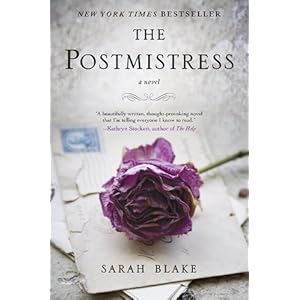
The PostmistressI also got The Postmistress by Sarah Blake recently, but I had to give it back to the library before I got anywhere. I heard some of it on Radio Reader, which is why I requested it. But things came up and it came due too soon. That's the good and the bad thing about the library. I don't have enough time, but I do have access to many more than I can buy.

My TBR stack is big enough to be a hazard now. I should quit buying or requesting anything for a while and try to catch up, at least a bit. There are so many good books I want to read. I still have Richard Helms's Six Mile Creek waiting, and I loved his Pat Gallagher books--also Grass Sandal, so I'd really like to get to this one.

So, shall I read or write? That's the question.

Sunday, October 17, 2010

A Hook and a Promise

Don’t you read at least the first paragraph before you decide on a book? The beginning of story lays down the promise for the rest of story and the author has to live by the rules she or he sets. I hate it when the opening of a book promises humor and delivers tragedy, or the opposite. I often chose my next read by my mood. Sometimes I want drama, sometimes light humor—whatever, the opening paragraphs guide my selection. If the book turns out to be something else, it’s a disappointment. So, writers, be careful to open with the right tone. 
The beginning of your story should do at least three things: get your story going and set the tone; introduce and characterize the protagonist; and above all, engage the reader's interest!

The opening scene can also create mood, introduce the narrator or narrative voice, introduce other characters (one or two, possibly even three, but too many is just confusing and dilutes interest in the main characters), the setting, time, and so on.

For example, volcanic openings—those with high drama—promise that the rest of the story will leave you breathless too.  It’s difficult to deliver on a promise like that.  Think about it. You may want to be a little more subtle in the opening, make a little less noise at the outset.  If it leads to melodrama later on, so be it.

Jennifer Crusie promises wit, romance, and a fun read in Fast Women.  It’s all there in the opening, and she keeps it going until the very end.
The man behind the cluttered desk looked like the devil, and Nell Dysart figured that was par for her course since she’d been going to hell for a year and a half anyway. Meeting Gabriel McKenna just meant she’d arrived.

Gwen Hunter opens Delayed Diagnosis with an ominous tone, and she delivered!
I had never been a coward, but it took all the courage I ever had to walk in to Marisa’s room. She was just sitting there, slightly slumped, her face and form in silhouette, framed by the window and rising sun. Unmoving. A mannequin in shadow.

I thought both of these books opened with a terrific hook and a promise. I’m sure you have examples of your own openings or other books with good openings. Share some! We all learn from seeing them.